I Remember When...
A Brief Autobiography
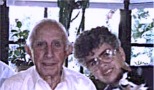
I was born in 1913. Our family lived in the small town of Malvern, Pennsylvania, about 20 miles west of Philadelphia. It's name derived from a small town of the same name in England. The school that I attended is still there as of this writing (1994). Some things seem to change but slowly there. My parents, like most people in those days, were hard working people. My father was of Swedish descent. His father came from Sweden, and his mother from Ireland. My mother emigrated from Ireland. I am the eldest of five brothers: William ( or Reds as he was nicknamed), Charles, Thomas, and Arthur.
One of my earliest memories is of a friend of our family getting off the train to come home after serving in the First World War. It was 1919, and he had to pass our house to reach his own home. It so happened that his girl friend was visiting us at the time, and when we happened to see him, walking by, we invited him in. I can remember the look of delight on his face as he took her into his arms after so much time away in such a terrible place. They hugged and kissed for what seemed like the longest time. Shortly after that, and to no one's surprise they were married. After some years in Malvern, we moved to a place called "the Valley."
The world of my Youth
My Father rented a farmhouse from Harry Weaver, a local farmer. This became my introduction to farm life. Mister Weaver's farm had many attractions; not the least of which were the field sledding on the gentle slopes of winter, and the many lost afternoons cooling off in the creek that wound it's way through the pastures and woods of summer. As we grew up, my brothers and I worked on many of the farms in the area. On one, we picked potatoes for 5 cents a bushel; on another, strawberries were picked for 3 cents a quart. And it was on that job, that for the first and last time, I was fired. Mr. Holland, the owner, was checking our progress and caught me eating more berries than I was packing. My severance pay was 10 cents and a hearty good-bye.
We lived in a time when indoor plumbing was still a relative luxury. There was an outhouse in the back; and our spare room contained a wash tub. When I was young, we had no electricity. Radio was still the toy of folks in the far away city, and even automobiles were seldom seen. Times were hard; life was difficult, but we were just happy to be with one another. In 1929, life became harder still, with the advent of the great depression. Millions were out of work, and even our small piece of America was greatly affected. In 1933 FDR became president, the New Deal began, and slowly, things began to improve. Roosevelt's theme song, "Happy Days are here Again" pretty much set the tone (and the tune) for the recovery. As a young man of the times, I'd have to admit I rather enjoyed those days. The big social event of the times were the regular dances held for us, which I attended 2 or 3 times a week. After the dance, my date and I would go out for dinner. Sandwiches cost around 15 cents, a cup of coffee went for a nickel, and a quarter would gain you admittance to the dance. For fifty cents, you could have a ball!
I meet the Love of my Life
One night, I met a very pretty girl, who just happened to stop in at the dance club with three of her friends as they were on the way back to Wilmington, Delaware where they lived. Her name was Helen Green. We were very attracted to one another and dated for over a year. In 1941, she became my bride. Helen's mother had native American and Irish roots, while her father was of English lineage, and a descendant of astronomer, Jeremiah Dixon, who with George Mason, had surveyed the Mason-Dixon line before the revolutionary War. Soon, we bought a dairy farm in Bucks county, in eastern Pennsylvania. It was a fine old place, with a large barn and an old two storey farmhouse whose thick, stone, walls were erected in the 1780's. We were as surprised as many Americans, to hear on the radio one cold winters evening, that the Japanese Navy had bombed Pearl Harbor, Hawaii. While I was exempt from Military service because of the importance of my occupation to the war effort, my brothers were all called up to serve. Bill (Reds) became a tank commander in General Patton's third army and participated in the liberation of Europe. Tom was seriously injured, and lost a leg in the Pacific. Brother Art "flew the hump" for General Stillwell in the struggle for China, and, sadly, My brother Charles, was killed on the Anzio beachhead in Italy, leaving a young widow and new daughter, Patricia. Everyone worked hard, and the victory in 1945 was shared by all of us. After the War In 1944, Jim was the firstborn of our four children. He was followed by his sisters, Ann Marie, Maureen, and Sheila. Jim and his wife Judy, live in Tallahassee, where he works in electronics, while she is a computer analyst for the state. As a result of an unfortunate birth defect, Ann Marie is developmentally disabled, but she is quite capable in her work at a local rehab center, and is doing very well. Maureen worked for the FBI for 12 years, and is now married to Tom Hicks with whom she lives happily with four children in Maryland. Sheila Worked for the Attorney-General's office in Tampa, and now lives with her husband, George Buxton, a bridge engineer, and her 3 children.
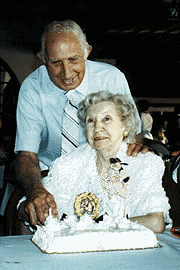
After nearly twenty years in the farm country of eastern Pennsylvania, Helen and I decided to move the family to the sunnier climes of Florida. I continued to work as Herdsman and Manager at a number of dairies in the Tampa area. We finally retired to the once small town of Spring Hill in an area just off Florida's west coast about 50 miles north of St. Petersburg. I lost Helen to Cancer in 1992. We had been married for over Fifty years, and had celebrated our Golden Anniversary just the year before. I miss her greatly. I now live with my daughter Ann Marie; retired, and ready when the Lord calls. June 1996
Joseph died January 11th, 2004
See their legacy here .
Form submission
